Global buyers rarely purchase poly sheeting for appearance alone. They purchase predictable performance under real conditions: a 200-micron roll in a humid warehouse, a wide sheet exposed to sunlight, or a liner facing sharp aggregate. Small specification gaps can create large costs, including tearing, rejected shipments, and production delays.
PlasticsEurope’s Plastics—The Facts 2023 reported global plastics production of 400.3 million tonnes in 2022. The OECD’s Global Plastics Outlook also found that only 9% of plastic waste was recycled in 2019. These figures make material selection more important, not less. Buyers must examine resin type, thickness tolerance, tensile strength, puncture resistance, UV stability, roll dimensions, and recycled content. A low quotation may hide inconsistent gauges or weak documentation.
Dr. Roland Geyer, a plastics-waste researcher, offers a useful warning: “There is no silver bullet for plastic pollution.” That caution applies to purchasing. Recycled poly sheeting may support resource goals, but its performance must match the application. Virgin material is not automatically better either. Ask for certificates of analysis, production samples, test methods, and destination-market compliance documents. Check whether the supplier tests finished rolls or only raw resin.
It sounds basic. It is not.
The following ten buying tips connect technical evidence with practical sourcing experience. They also recognize an uncomfortable truth: buyers sometimes compare prices before defining performance. That habit deserves reconsideration. A reliable decision begins with measurable requirements, transparent supplier records, and a clear understanding of how the sheet will be stored, handled, and used.
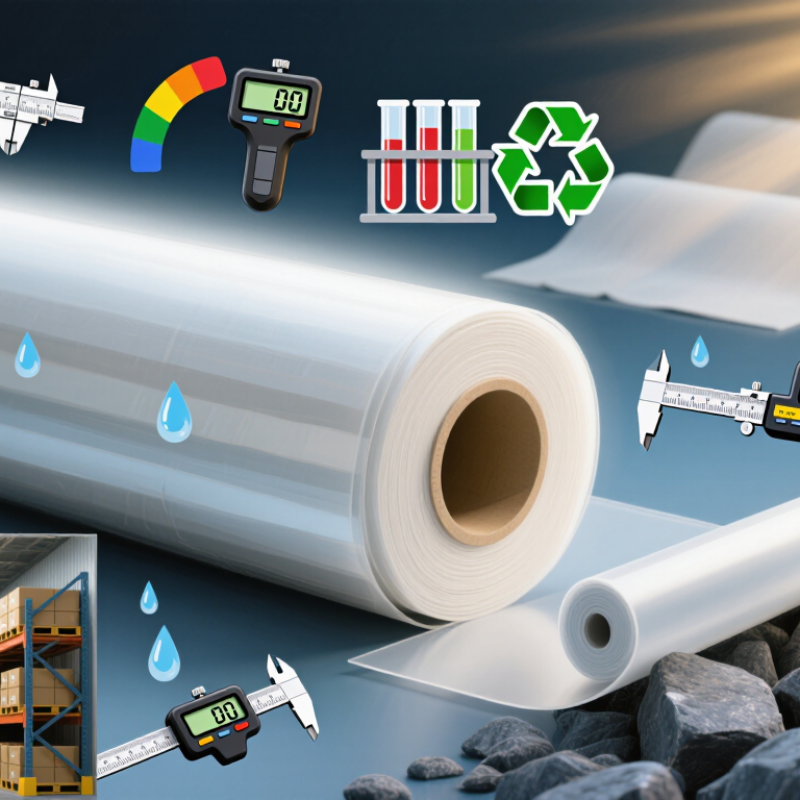
Poly sheeting buying begins with thickness, not appearance. The key benchmark is simple: 1 mil equals 25.4 μm. A 4 mil sheet measures about 101.6 μm. Always confirm whether a supplier quotes nominal or minimum thickness. ISO 4593 describes film-thickness measurement methods, while ASTM D2103 covers polyethylene film and sheeting classifications. These references help buyers compare products across countries.
Material Selection
Identify the resin first. LDPE offers flexibility and easy folding. HDPE usually provides greater stiffness and puncture resistance. Reinforced sheeting suits demanding covers, while UV-stabilized grades support outdoor exposure. Ask for width, roll length, thickness tolerance, tensile strength, tear strength, and puncture data. Check temperature limits too. Request a sample roll. Small tests reveal handling problems quickly.
A practical checklist includes resin type, mil-to-micrometer conversion, measured thickness, tolerance, width, length, strength, UV performance, packaging, and documentation. Request a certificate of analysis for each production lot. PlasticsEurope’s Plastics—The Fast Facts 2024 estimates global plastics production reached 430.9 million tonnes in 2023. That scale makes material traceability increasingly important. Recycled content may reduce environmental impact, but it can change color, odor, and consistency. Do not assume “heavy duty” means identical performance. I still ask for independent test results. Supplier tables can look reassuring. They are not proof of field performance.

Material selection often determines whether poly sheeting performs well in storage, construction, agriculture, or packaging. LDPE offers excellent flexibility and clear appearance. It suits liners, covers, and applications requiring easy folding. However, thin LDPE can tear around sharp corners.
HDPE provides stronger stiffness, puncture resistance, and moisture protection. It works well for ground covers, protective barriers, and demanding outdoor use. LLDPE stretches better than LDPE and often resists impact more effectively. This makes it useful when loads shift or surfaces move. Recycled resin can reduce material costs and environmental pressure, but quality may vary between batches. Color, odor, tensile strength, and thickness can change.
Tip: Ask for resin percentages, thickness tolerance, test reports, and sample rolls. Do not judge quality from appearance alone. A smooth surface can hide weak seams. In my sourcing experience, buyers sometimes choose the cheapest kilogram and later pay for replacements, labor, and delays. That calculation is incomplete. Compare cost per usable square meter instead.
Tip: Match the resin to the working conditions. Consider temperature, sunlight, stretching, puncture risks, and expected service life. A buyer may over-specify film for a short indoor project. That wastes budget. Yet selecting recycled resin for critical outdoor exposure may create avoidable uncertainty. Request production records and inspect samples under realistic handling conditions. Supplier claims deserve verification.
Global buyers often compare price before performance, yet thin poly sheeting can fail at the pallet edge. ASTM D882 measures tensile properties, including strength, elongation, and modulus, in controlled film specimens. Request machine-direction and transverse-direction results. Film is not equally strong both ways. ASTM D1709 uses a falling dart to assess impact resistance, exposing brittle formulations and weak seals. Ask for dart mass, conditioning temperature, and failure percentage, not only a pass label.
ASTM D2582 evaluates propagation tear, which matters when a puncture starts beside a sharp carton corner. Record tear direction, specimen thickness, and test temperature. A low tear value can turn a tiny nick into a long split. PlasticsEurope reports 400.3 million tonnes of global plastics production in 2022. The scale is huge. That volume does not make quality consistent. Supplier reports should identify sampling plans, laboratory equipment, calibration dates, and actual batch numbers. Without those details, a polished certificate remains difficult to verify.
The OECD Global Plastics Outlook estimates 353 million tonnes of plastic waste were generated in 2019, with only 9% recycled. For buyers, recycled content or downgauging can change tensile, impact, and tear behavior. Compare at least three production lots. Inspect rolls under real handling conditions. I would also keep failed samples. They reveal more than averages. One practical mistake is accepting a single-direction test. That shortcut looks efficient, but it can hide splitting during installation.
Global buyers should treat compliance as a specification, not a final paperwork check. Under REACH, poly sheeting may require substance disclosure, especially when additives, pigments, or recycled content are used. The European Chemicals Agency reported non-compliance in about 18% of products checked during a recent enforcement project. That figure is uncomfortable, but useful. Ask for a current declaration, substance list, and test date.
RoHS limits ten restricted substances in electrical and electronic equipment, including lead, mercury, and certain phthalates. It may not apply to every plastic sheet. The product’s end use decides that. Food-contact applications require more care. EU Regulation 1935/2004 and Regulation 10/2011 address safety and plastic migration. Request overall migration results, specific migration data, and declarations for the target market. One generic “food grade” statement is weak evidence. Temperature and contact time matter.
HS classification also deserves technical review. The WCO HS 2022 edition contains 5,600-plus six-digit subheadings, and plastic sheeting may fall under different headings based on cellular structure, reinforcement, coating, and intended form. Do not copy a supplier’s code without checking customs guidance. A small description error can change duty, documentation, and clearance risk. In practice, buyers should compare the commercial invoice, product drawing, resin composition, and laboratory report. Compliance files are never perfect; new formulations or recycled inputs can reopen old assumptions.
10 Poly Sheeting Buying Tips for Global Buyers
MOQ should match your storage space and sales forecast, not only the supplier’s preference. A low MOQ may increase unit pricing, while a large order can create cash-flow pressure. Request tiered pricing for several volumes. Confirm whether prices include printing, cores, cartons, pallets, and export documents. Ask how long the quotation remains valid. Resin costs can change quickly.
Packaging needs practical detail. Specify roll diameter, film thickness, width tolerance, moisture protection, carton strength, pallet height, and container loading limits. Request photos of a packed shipment. Small details matter. Choose Incoterms carefully. Under FOB, you manage the main freight; under DDP, the seller handles more delivery steps and charges. Confirm responsibilities for insurance, customs clearance, and unloading before signing.
Use this 10-point supplier audit checklist: 1) legal company details, 2) MOQ flexibility, 3) material grade, 4) thickness testing, 5) width tolerance, 6) production capacity, 7) packaging control, 8) Incoterm clarity, 9) inspection records, and 10) corrective-action history. Ask for recent test reports, production photos, and two trade references where appropriate. A video audit helps, but it cannot replace independent inspection. I once trusted a clean sample too quickly; the bulk rolls showed uneven winding. Build approval around measurable tolerances, not confidence alone.